

Important Khmer Phrases for traveler

The Khmer language is the official language of Cambodia, spoken by over 16 million people. It is a member of the Austroasiatic language family, which connects it historically to Vietnamese and Mon, rather than Thai or Lao.
Here is a brief overview of how the language works, and some of the important phrases that are useful for you when you are visiting Cambodia
The Alphabet:
The Khmer script is recognized by the Guinness Book of World Records as having one of the largest alphabets in the world.
Instead of standard letters, it is an abugida (a writing system where consonants and vowels are blended together into a single sound unit). The script consists of:
33 Consonants
23 Dependent Vowels (vowels that must attach to a consonant to make a sound)
12 Independent Vowels (vowels that can stand completely alone)
A unique feature of writing Khmer is subscript consonants. When two consonants are written next to each other, the second consonant is shrunk and written underneath the first one (called a Cheung Akhor or "foot of the letter").
We are not here to make you fluent in the Khmer language, but rather to share some important words and phrases that will be helpful to you during your time in Cambodia. By writing this blog, our aim is to be a part of preserving local heritage while encouraging travelers to actively participate in and respect our local culture.
Here are some important phrase for travelers
1. How to Ask Questions with “Te”
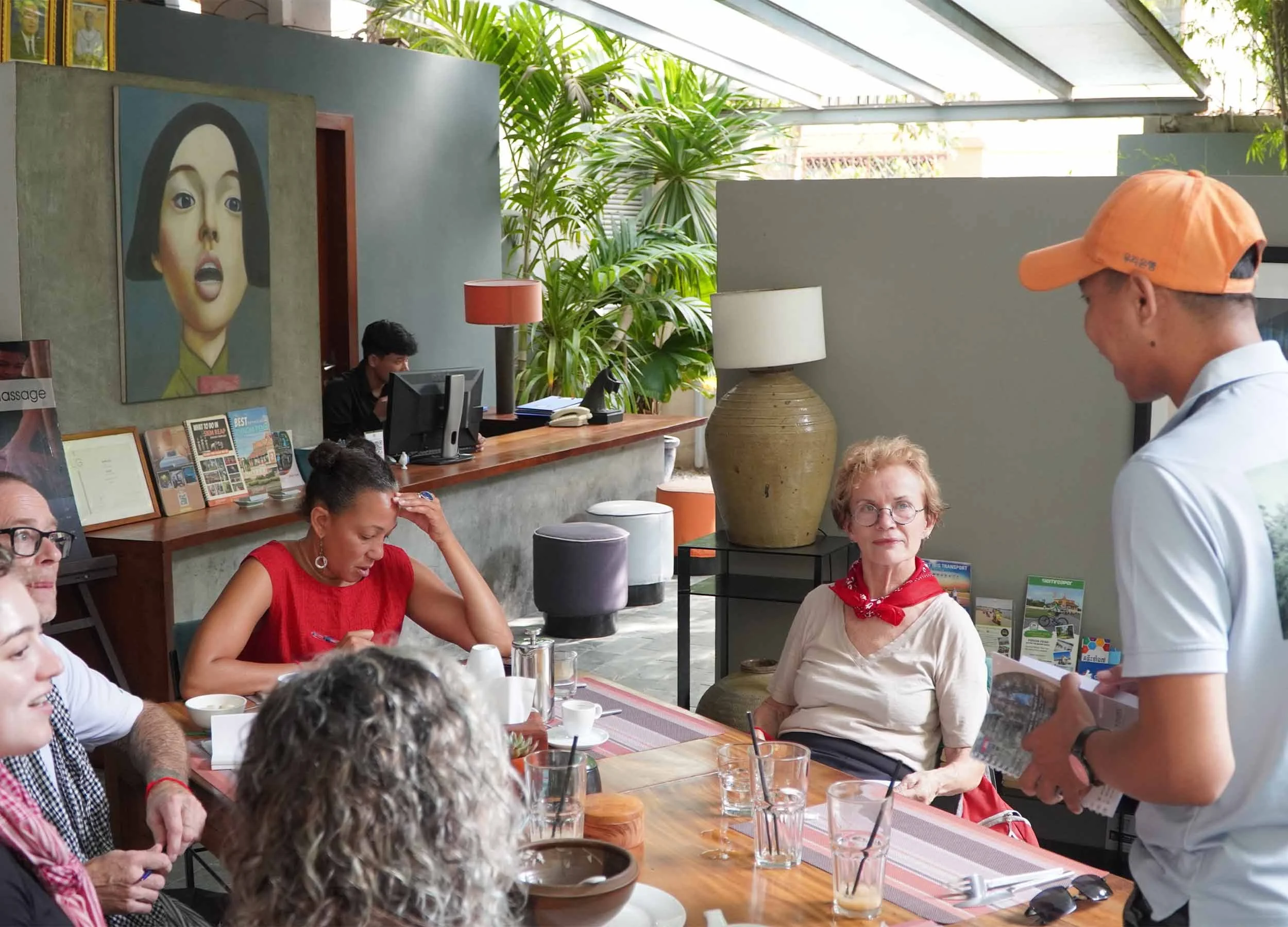
Tour leader walk our guest through important Khmer words
An easy way to ask a yes/no question in Khmer is by adding the particle “tei” (ទេ) at the end of a statement. You can place “tei” after a noun, verb, or adjective, depending on what you want to ask.
Structure: [Statement] + tei?
Examples:
Soks-sa-bay tei? (How are you doing?)
Choul-chet tei? (Do you like it?)
If you want to be more specific, you can add a name or a pronoun at the beginning to show exactly who you are asking.
Neak soks-sa-bay tei? (How are you doing? — using "Neak" for "you")
Tola nham bay tei? (Is Tola eating rice? / Tola, are you eating?)
2. How to Say No with “Ot Tei”
In Khmer, “Ot tei” (អត់ទេ) is a common and easy way to say “no” or “no, thank you.” It is most often used to reject an offer or to disagree with something in casual conversation.
While “Ot tei” is casual, it is widely accepted and polite enough for everyday situations—especially when turning down food, drinks, or a vendor at the market.
Example:
Someone offers you more rice → You reply: “Ot tei, ar-koon” (No, thank you.)
It’s simple, clear, and understood by everyone, making it a highly useful phrase for navigating local interactions.
3. Offering and Asking with “Oy” (Give / Allow)
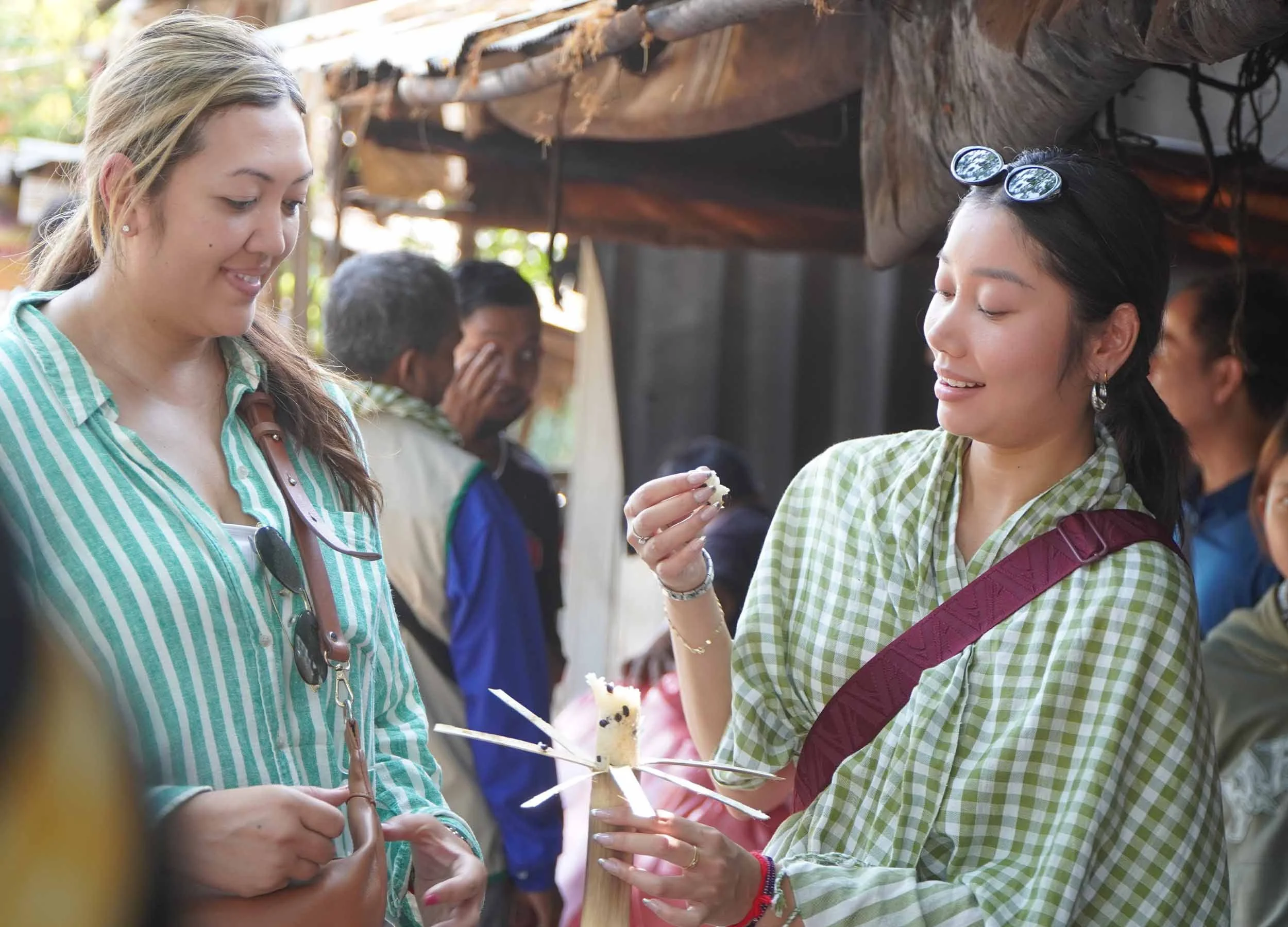
Visit local village, trying local snack
In Khmer, the word “Oy” (ឲ្យ) carries a beautiful range of meanings centered around the act of giving. Depending on the context, “Oy” can mean to give, to offer, to allow, or to ask for permission.
Oy seav-phou khnom = Give me the book. [Request/Command]
Oy khnom juy tei? = Can I help you? / Let me help? [Offering Help]
Oy koat tov = Let him go, please. [Permission]
Each of these examples reflects a slightly different use of "Oy," but they all stem from a shared Cambodian cultural value: thoughtfulness in action—whether you’re offering help, granting permission, or making a respectful request.
4. Stating Destinations with “Jong Tov” (Want to go)
The word “Tov” means to go, and “Jong” means want. Putting them together creates “Jong tov” (I want to go). This is the perfect phrase to use with Tuk-Tuk drivers!
Examples:
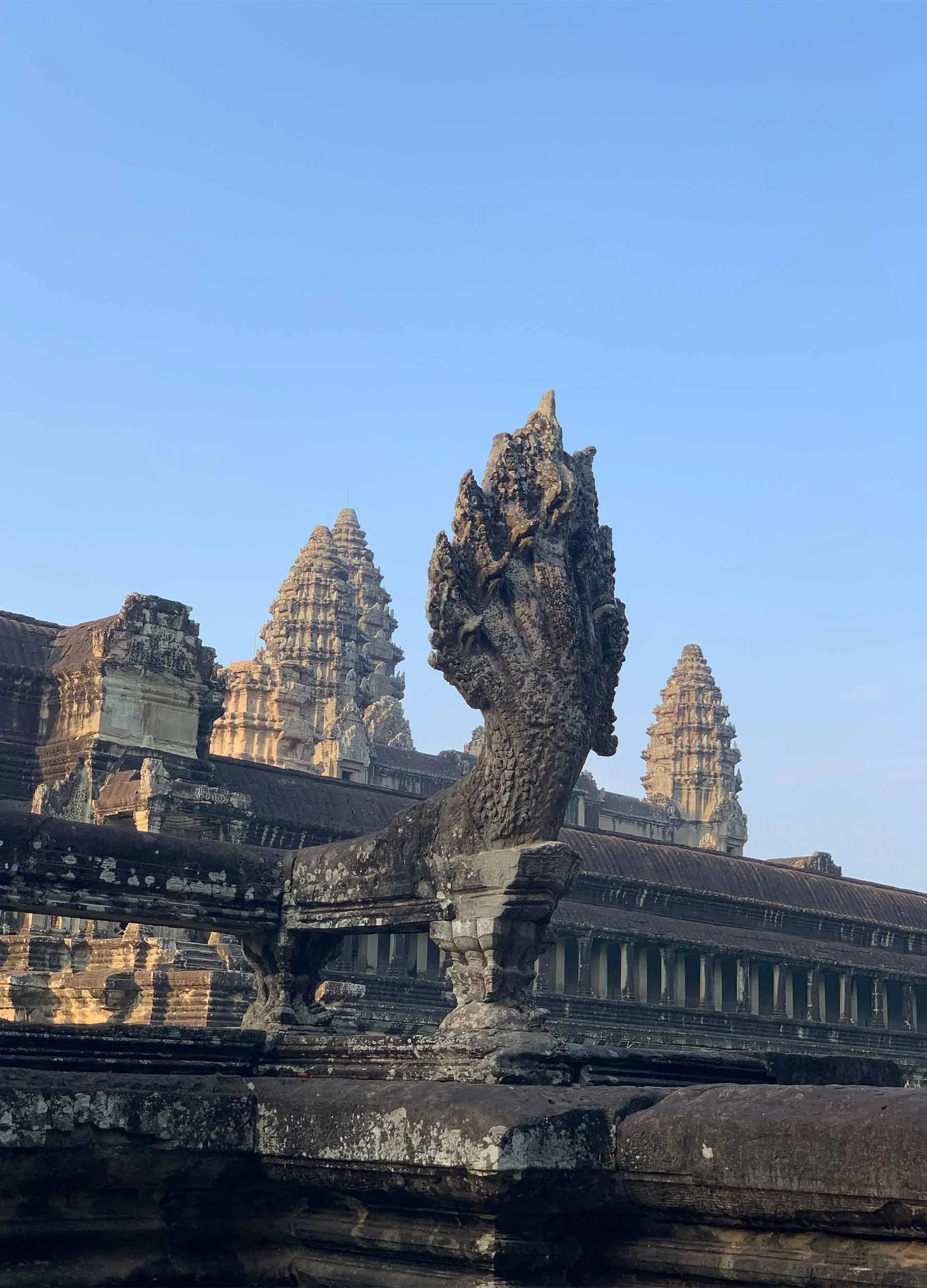
Knhom jong tov Angkor Wat. (I want to go to Angkor Wat.)
Knhom jong tov Phsar Reatrey. (I want to go to the Night Market.)
5. Expressing Desires: “Jong Ban” (Want) vs. “Trov-kar” (Need)
In Khmer, you can use “Jong ban” (ចង់បាន) for "I want" or “Trov-kar” (ត្រូវការ) for "I need" when buying or asking for something.
Examples:
Knhom jong ban seav-phou mouy. (I want one book.)
Knhom trov-kar ka-fe mouy. (I need a cup of coffee.)
Knhom jong ban arv nih. (I want this shirt.)
Koat jong ban bay mouy teat. (She wants one more plate of rice.)
You can use either phrase when shopping—both are common, clear, and easy to understand.
6. Talking About Objects: “Nih” (This) and “Nuh” (That)
In Khmer, “Nih” (នេះ) means “this” and “Nuh” (នោះ) means “that.” Just like in English, use “nih” for something near you, and “nuh” for something farther away.
Examples:
Nih chea krou khnom. (This is my teacher.)
Seav-phou khnom nov nih. (My book is here.)
Nuh chea preah chan. (That is Chan’s house.)
Ka-bop khnom nov nuh. (My bag is over there.)
We believe that travel becomes more powerful and meaningful when travelers and local communities can learn from each other by enhancing mutual opportunities. We created this blog to be a resource for travelers to use during their local village visits. We hope this blog will allow you to use some of these Khmer words to interact with the local people you meet on your trip.